
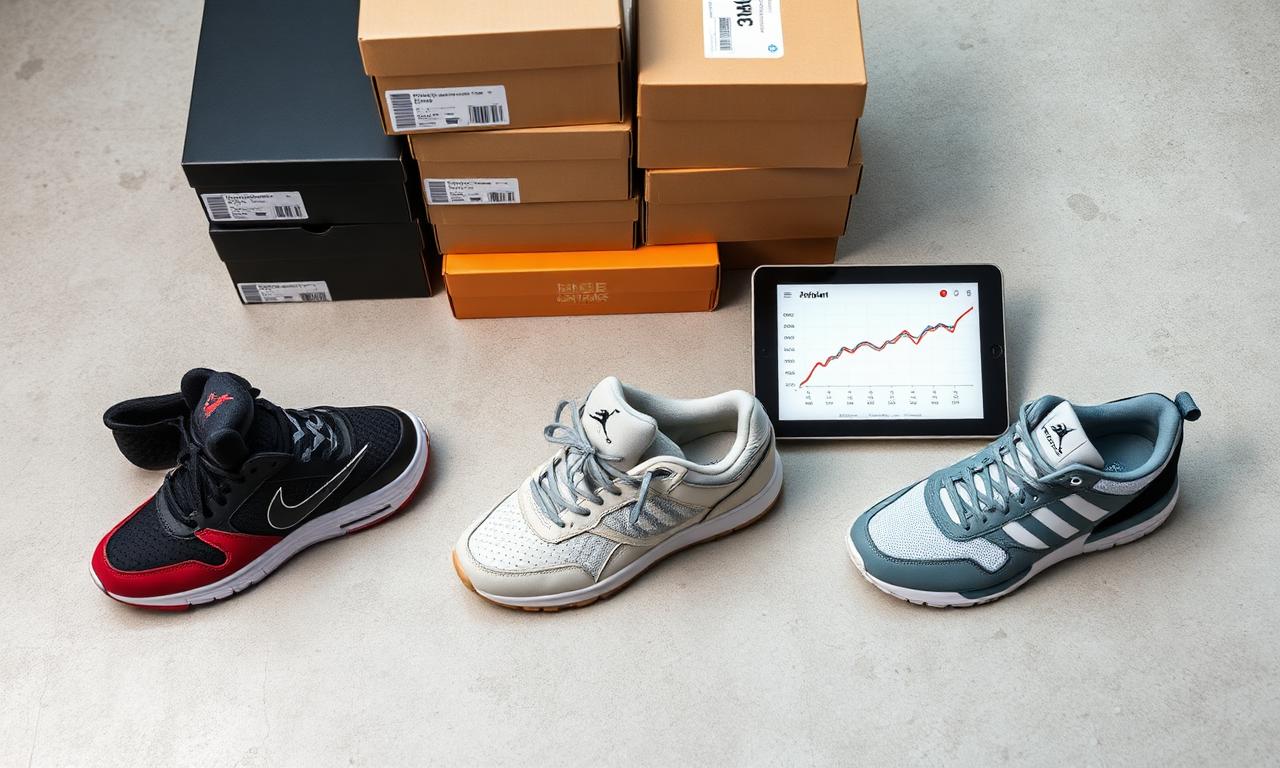
Sneakers are an asset class now
Modern sneaker reselling stopped being a hobby around 2015 when StockX launched live bid/ask pricing. Since then, limited sneakers behave less like clothing and more like trading cards or low-cap equities: real-time market depth, public sales comps, volatility around drops, and clear winners and losers per silhouette.
The global sneaker resale market is estimated at $10B+ and growing double digits annually. The opportunity is real but the easy money phase (2017–2021) is over — margins compressed, Nike SNKRS reduced bot wins, and StockX/GOAT fees climbed. Today's resellers win on systems, capital efficiency, and category specialization, not luck.
The three demand drivers you trade around
Scarcity: Nike, Jordan Brand, Adidas, and New Balance deliberately under-produce specific colorways. Lower supply vs. expected demand creates the spread between retail and resale.
Hype: collaborations (Travis Scott, Off-White, Fragment, Patta), retro nostalgia (Jordan 1, Dunk, AJ4), and cultural moments (an NBA finals, a music video) shift demand curves overnight.
Utility: comfort and on-foot wearability matter long term. A pair that 'sells out but no one wears' (e.g. some bulky collabs) bleeds value six months later. Pairs that are scarce AND wearable (Travis 1s, Chicago Lost & Found) hold premiums for years.
Where the trades happen
StockX: largest live order-book marketplace. Buyer pays + ~3% processing, seller pays 9% transaction fee + 3% payment fee (lower with seller level). Authenticated centrally. Fastest exit, lowest price.
GOAT: editorial feel, often gets slightly higher prices than StockX on hyped pairs. Seller fees start at 9.5% + $5 commission. Listings are 'asks', less of a true bid book.
eBay: best for unusual sizes, vintage pairs, and bulk lots. Authenticity Guarantee covers $100+ sneakers. Fees ~13% all-in. Highest possible price, slowest sale.
Local / Discord / IG: zero fees, instant cash, but you carry authentication risk and meet-up risk. Use only with established community reputation.
How prices actually move around a drop
Pre-release: ask prices on StockX appear 1–2 weeks early. They are usually too high — sellers are anchoring optimistically. Real price discovery starts 48h after release once volume hits.
Release day to day 7: prices drop the fastest as resellers dump inventory to recycle capital. This is the worst window to sell hyped pairs unless you bought at retail and any number is profit.
Day 30 to month 6: the 'dead zone'. Hype fades, buyers go quiet, prices often dip below release-week lows. Patient holders win here.
Month 6 to year 2: if the pair has staying power (silhouette + colorway + cultural anchor), prices grind back up. The Travis Scott Mocha 1 retailed $175, hit a low around $1,100 post-release, and now trades $1,800–$2,500 four years later.